Civil Engineering

- Course Duration:
- Intake:
- No. of Faculty:
COURSE OVERVIEW
Civil engineering, traditionally one of the broadest of engineering disciplines, expands the limits of possibilities. It encompasses the challenges of complex structural designs, eco-friendly housing, sustainable infrastructures, flood & water management, soil stabilization, construction management, environmental consciousness and more.
Established in 2013, the Department of Civil Engineering; headed by Dr. G Aruna: is defined by its singular strengths, collaborative synergies, and its commitment to excellence. The department offers programs at an Undergraduate level with an AICTE approved intake of 60 and houses excellent laboratories, classrooms, and computing facilities for teaching and research.
Our departmental values of "Building Partnerships" links students, faculty, and industry into a team to provide quality education, research, and development enterprise. The Civil Engineering program provides competitive advantages and prepares student graduates for a rewarding career. Student capacity building is ensured through excellent student internship opportunities, Outstanding and promising Projects, and ICI- student chapter activities. The department promotes student involvement in constructive co-curricular activities like state-level sports, National Service Scheme, social initiative groups and others. Through continuous improvement processes, the department aims at being a pioneer at the frontier of knowledge and innovation in Civil Engineering.
E-Learning
.jpg)
LALIT KUMAR- Design of R C Structural Elements-01
.jpg)
LALIT KUMAR-3rd Year Design of R C Structural Elements-02
.jpg)
ARCHNA 01- 2nd Year 3dr Sem- Fluid Mechanic & Machinery-01
.jpg)
ATHIYAMAAN- 2nd Year 3dr Sem- Solid Mechanics-01
.jpg)
ARCHNA 02- 2nd Year 3dr Sem- Fluid Mechanic & Machinery-02
.jpg)
ARCHNA 03- 2nd Year 3dr Sem- Fluid Mechanic & Machinery-03
.jpg)
ATHIYAMAAN- 2nd Year 3dr Sem- Solid Mechanics-02
.jpg)
CIVIL- ATHIYAMAAN- 2nd Year 3dr Sem- Solid Mechanics-03
.jpg)
Dr G ARUNA 01- 3rd Year 5th Sem- AIS-01
.jpg)
Dr G ARUNA 01- 3rd Year 5th Sem- AIS-01A
.jpg)
Dr G ARUNA 02 - 3rd Year 5th Sem- AIS-02
.jpg)
Dr G ARUNA 03A- 3rd Year 5th Sem- AIS-03A
.jpg)
Dr G ARUNA 032 - 3rd Year 5th Sem- AIS-03
.jpg)
Dr. LALIT KUMAR-3rd Year Design of R C Structural Elements-03
.jpg)
Dr. LALIT KUMAR-3rd Year Design of R C Structural Elements-04
.jpg)
Dr. LALIT KUMAR-3rd Year Design of R C Structural Elements-05
VISION
To be an Exemplary Centre, disseminating quality education and developing technically competent civil engineers with professional integrity for the betterment of society.
MISSION
- Impart technical proficiency through quality education.
- Motivate entrepreneurship through enhanced industry - interaction and skill based training.
- Inculcate human values through outreach activities.
- Lead a successful career by analyzing, designing and solving various problems in the field of Civil Engineering.
- Execute projects through team building, communication and professionalism.
- Excel through higher education and research for endured learning.
- Provide effective solution for sustainable environmental development.
- PO1 Engineering Knowledge: Apply knowledge of mathematics, natural science, computing, engineering fundamentals and an engineering specialization as specified in WK1 to WK4 respectively to develop to the solution of complex engineering problems.
- PO2 Problem Analysis: Identify, formulate, review research literature and analyze complex engineering problems reaching substantiated conclusions with consideration for sustainable development. (WK1 to WK4)
- PO3 Design/Development of Solutions: Design creative solutions for complex engineering problems and design/develop systems/components/processes to meet identified needs with consideration for the public health and safety, whole-life cost, net zero carbon, culture, society and environment as required. (WK5)
- PO4 Conduct Investigations of Complex Problems: Conduct investigations of complex engineering problems using research-based knowledge including design of experiments, modelling, analysis & interpretation of data to provide valid conclusions. (WK8).
- PO5 Engineering Tool Usage: Create, select and apply appropriate techniques, resources and modern engineering & IT tools, including prediction and modelling recognizing their limitations to solve complex engineering problems. (WK2 and WK6)
- PO6 The Engineer and The World: Analyze and evaluate societal and environmental aspects while solving complex engineering problems for its impact on sustainability with reference to economy, health, safety, legal framework, culture and environment. (WK1, WK5, and WK7)
- PO7 Ethics: Apply ethical principles and commit to professional ethics, human values, diversity and inclusion; adhere to national & international laws. (WK9)
- PO8 Individual and Collaborative Team work: Function effectively as an individual, and as a member or leader in diverse/multi-disciplinary teams.
- PO9 Communication: Communicate effectively and inclusively within the engineering community and society at large, such as being able to comprehend and write effective reports and design documentation, make effective presentations considering cultural, language, and learning differences
- PO10 Project Management and Finance: Apply knowledge and understanding of engineering management principles and economic decision-making and apply these to one’s own work, as a member and leader in a team, and to manage projects and in multidisciplinary environments.
- PO11 Life-Long Learning: Recognize the need for, and have the preparation and ability for i) independent and life-long learning ii) adaptability to new and emerging technologies and iii) critical thinking in the broadest context of technological change. (WK8)
- WK1 A systematic, theory-based understanding of the natural sciences applicable to the discipline and awareness of relevant social sciences.
- WK2 Conceptually-based mathematics, numerical analysis, data analysis, statistics and formal aspects of computer and information science to support detailed analysis and modelling applicable to the discipline.
- WK3 A systematic, theory-based formulation of engineering fundamentals required in the engineering discipline.
- WK4 Engineering specialist knowledge that provides theoretical frameworks and bodies of knowledge for the accepted practice areas in the engineering discipline; much is at the forefront of the discipline.
- WK5 Knowledge, including efficient resource use, environmental impacts, whole-life cost,reuse of resources, net zero carbon, and similar concepts, that supports engineering design and operations in a practice area.
- WK6 Knowledge of engineering practice (technology) in the practice areas in theengineering discipline.
- WK7 Knowledge of the role of engineering insociety and identified issues in engineering practice in the discipline, such as the professional responsibility of an engineer topublic safety and sustainable development.
- WK8 Engagement with selected knowledge in the current research literature of the discipline, awareness of the power of critical thinking and creative approaches to evaluate emerging issues.
- WK9 Ethics, inclusive behavior and conduct. Knowledge of professional ethics, responsibilities, and norms of engineering practice. Awareness of the need for diversity by reason of ethnicity, gender, age, physical ability etc. with mutual understanding andrespect, and of inclusive attitudes.
Program Outcomes (POs)
Knowledge and Attitude Profile (WK)
- Graduates will be able to plan, analyse, design and detailing of civil engineering structures ensuring safety, cost efficiency, codal provisions, and ethical practices by applying engineering principles and modern tools.
- Graduates will be able to apply modern construction methods, multidisciplinary technologies, and project management principles to address complex civil engineering challenges, fostering sustainability, innovation, and social responsibility.
Faculty List
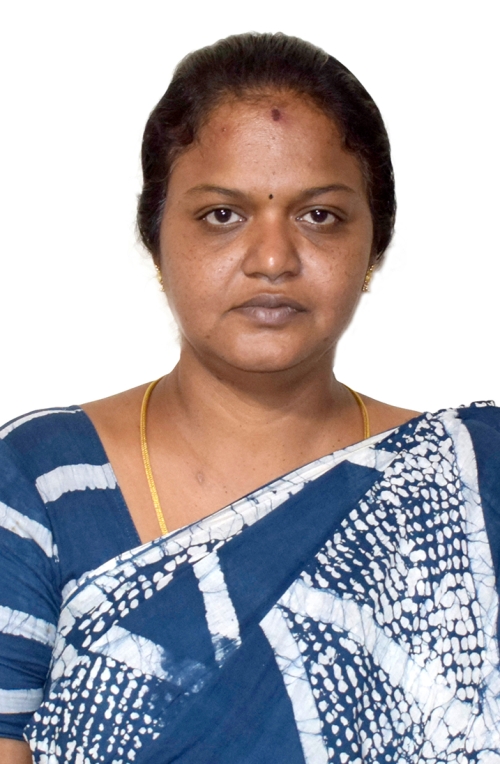
Dr Aruna G
Associate Professor and HoD
Civil Engineering


- Ph.d
- Completed ISO 9001:2015 Internal Auditor Certification – Quality Management Systems (QMS).
- Received a Certificate of Appreciation for Outstanding Contribution towards Academics in the year 2022-2023 during the Teacher’s Day Celebrations 2023 at BMSIT&M.
- Successfully handled critical courses, consistently achieving more than 80% student pass rate.
- Structural Engineering
- IEI, ISTE, and IAENG
- Velumani Periasamy, Aruna Govindan, and Saravanan Ramasamy,” Axial compression behavior of edge stiffened C-profile aluminium alloy: a finite element analysis, RevustaMAteria V30, 2025 ,Doi.org/10.1590/1517-7076-RMAT-2024-0720
- Aruna G, Krishanu Roy , James B P Lim and Suresh kumar P “ Cold-Formed Steel Equal Angle with Complex Edge Stiffeners under Axial Compression – Laboratory Testing , Numerical Simulation , and Design , Practice Periodical on Structural Design and Construction (ASCE) , DOI: 10.1061/(ASCE)SC.1943-5576.0000678 (2022)
- Aruna G, Sukumar S & Karthika “Finite element analysis and design of cold-formed built-up closed columns with flange and web intermediate stiffeners”, Canadian Journal of Civil Engineering, 47 (2020), pp. 1175–1187
- Aruna G, & Sukumar S “Stub columns tests of cold-formed steel built-up square sections with intermediate stiffeners”, Strength of Materials, Vol. 52, No. 2 (2020), pp. 281-290,
- Aruna G, & Sudharsan N “Study on assessment of outcomes of education” Journal of Engineering Education Transformations, Vol. 33, No. 04 (2020), pp. 38-43
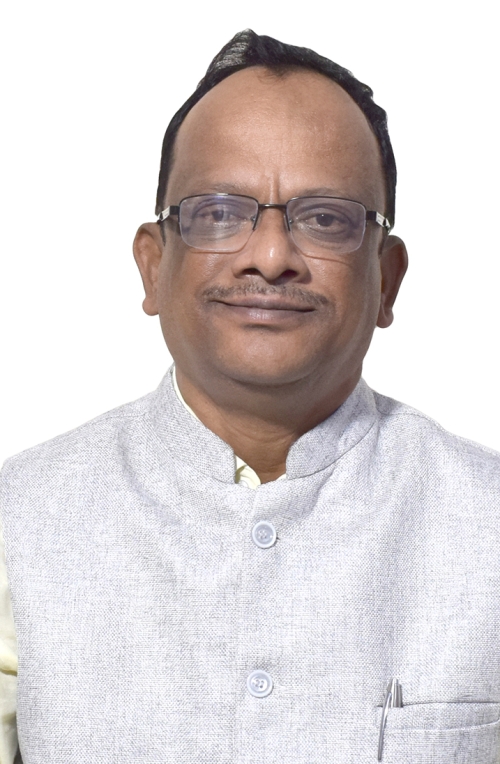
Dr. Rajakumara H N
Professor & Dean (Academic Affairs)
Civil Engineering
- B.E., M.Tech., PhD
- “CAREER AWARD FOR YOUNG TEACHERS (CATY)” from AICTE with a grant of Rs. 10.50 Lakhs
- Fellow Member of Institution of Engineers (India) (F-121351-9)
- Patent on “Manufacture of Bamboo Bricks” application on Building blocks (Patent No 201841029704)
- Environmental Engineering
- Life member of Indian Society for Technical Education (LM: 29027
- Life Member of Acoustical Society of India (LM: 689]
- Fellow Member of Institution of Engineers (India) (F-121351-9)
- Storm water runof studies in built‑up watershed areas using curve number and remote sensing techniquehttps://doi.org/10.1007/s43621-025-00828-3s 2.
- Evaluation of optimal route selection for public transport network routes on urban roads using Fuzzy-TOPSIS method. https://doi.org/10.1002/eng2.12794
- Assessment of Airport Noise Exposure Around Kempegowda International Airport and Spatial Interpolation using Geographical Information System.IJEP 42(11): 1353-1360 : Vol. 42 Issue. 11 (November 2022)
- Study of Traffic Noise in Urban Street Canyons of Bengaluru City.https://doi.org/10.18520/cs%2Fv110%2Fi6%2F1072-1078
- Analysis of Urbanization-Induced Flooding in the Koramangala-Challaghatta Valley of Bangalore City Using Remote Sensing and GIS. DOI:10.1007/978-981-97-0072-1_43
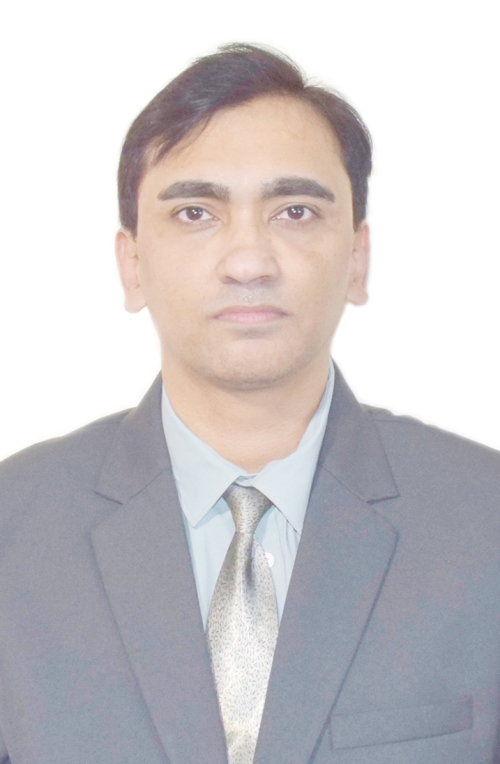
Dr Rajesh Gopinath
Professor
Civil Engineering
B.E., M.Tech, MBA, PhD, CSM (IISc), PGD Env Law (NLSIU), DIS
- Green Teacher Award - 2025
- Guru Shreshta Puraskar - 2024
- Global Environment and Climate Educator Award - 2022
- Completed AICTE-QIP-PG- Certification Program on "IoT" at IIT Jammu, J&K
- Recipient of research funding of Rs. 4.5 Lakhs from Bureau of Indian Standards
- Environmental Engineering
- MISTE, MISCA, MIWRS, MIAENG
- Relative analysis for carbon sequestration potential of prominent private and public green spaces in bengaluru, India. Civil and Environmental Engineering Reports, 34(2), pp. 224-241. 2024, ISSN 2450-8594, Romania Web of Science https://doi.org/10.59440/ceer/189915
- An investigation into the influence of public green spaces for the climate of Bengaluru. Present Environment and Sustainable Development, 17(2), pp. 85-99. 2023, ISSN 2284-7820, Romania Web of Science
- Augmentation of Soil-Moisture Retention with Natural Hydrogel Extracted from Fenugreek Seed Husk for Loamy Soil with Real-Time Monitoring Using FC-28 Sensors. ECS Transactions, 107(1), pp. 1139-1152. 2022, ISSN 1938-5862, USA Scopus https://doi.org/10.1149/10701.1139ecst
- Time-line based aerial analysis for impact of rampant urbanization on lakes of bengaluru (India). Civil and Environmental Engineering Reports, 32(1), pp. 1-18. 2024, ISSN 2450-8594, Romania Web of Science
- Spatial and temporal real-time ambient Carbon Monoxide ward–wise mapping for Bengaluru City. Present Environment and Sustainable Development, 15(1), pp. 23-33. 2021, ISSN 2284-7820, Romania Web of Science
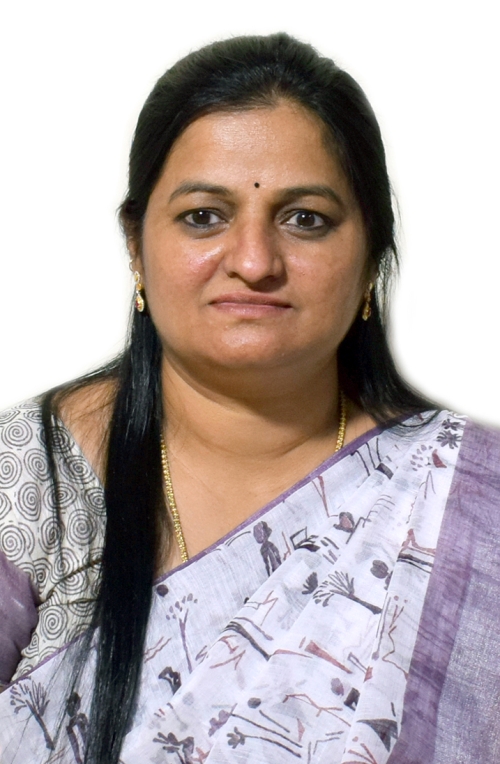
Mrs.Shobha R
Assistant Professor
Civil Engineering
- B.E., M.Tech.
- Authored a technical textbooks in the domain of Civil Engineering.
- Recognized as applicant and inventor with 2 granted patents.
- 4 published patent filings.
- Structural Engineering(CADS)
- MISTE , ICI , IIB , ACCE
- Banana fibre as alternative thermal insulation and comparison with conventional thermal insulation in buildings
- R Shobha , B. R. Vinod “Pineapple fiber as an Effective Thermal Insulator Compared to other Insulating Materials ” Innovations and Applications of Fiber-Reinforced Concrete, Materials science and Technologies , Nova Science Publishers, New York , ISBN 978-8-89113-529-1 (eBook), DOI: https://doi.org/10.52305/EWVP0213 Page Number : 135-154, 6th March 2024.
- The Influence of Infill Masonry Wall in RC Frames Subjected to Seismic Load for Sustainable Structure Ramachandra S.;Ramakrishna V.B.;Vasantha ;Vedant V. Conference Paper IOP Conference Series: Materials Science and Engineering, Volume 955, Year 2020 DOI:10.1088/1757-899X/955/1/012024
- Response of Tall Structures Along Face Exposed to Blast Load Applied at Varying Distance Shobha R, Vinod B R, Anusha P Prabhu, Shubhashree G R, Yaksha V International Journal of Recent Technology and Engineering (IJRTE), Volume 9, Year 2020, Pages 455-460 DOI:10.35940/ijrte.A1591.059120
- Lightweight concrete blocks produced using expanded polystyrene and foaming agent B.R. Vinod ., H.J. Surendra ., R. Shobha .,Conference Paper Materials Today: Proceedings, Volume 52, Year 2022, Pages 1666-1670 DOI:10.1016/j.matpr.2021.10.503
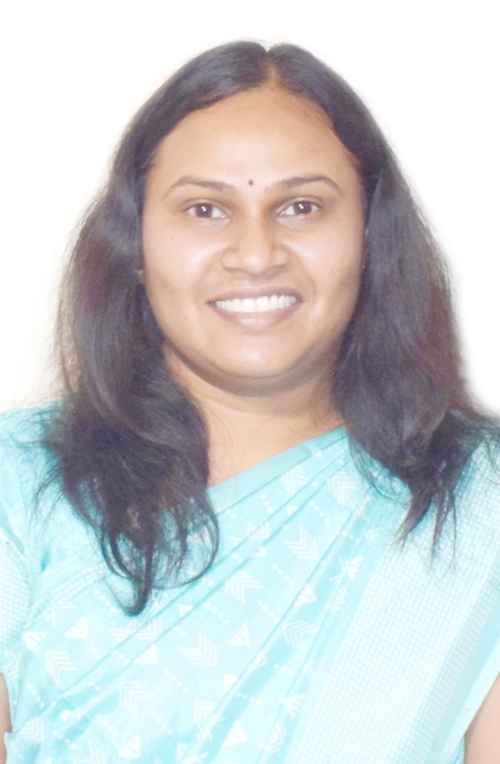
Prof. Archana K
Assistant Professor
Civil Engineering
- B.E., M.Tech., PG ( Machine Learning) IISc
- Completed AICTE-QIP-PG- Certification Program on "Machine Learning" at IISc, Bengaluru
- Recipient of research funding of Rs. 4.5 Lakhs from Bureau of Indian Standards
- First Rank Holder in Masters ( M Tech- WREM) , NITK
- Water Resources Engineering & Management
- Life member of Indian Society for Technical Education (LM: 29027)
- Life Member of Acoustical Society of India (LM: 689]
- Fellow Member of Institution of Engineers (India) (F-121351-9)
- Archana, K., Deepak, M.S., Bharath Singh, B.D., Deepthi, B.R., Kumar, H.V., Sadaf, S.A. (2024). Study on Development of FRC and Its Application in Sluice Gate. Recent Advances in Structural Engineering. IACESD 2023. Lecture Notes in Civil Engineering, vol 455. Springer, Singapore. https://doi.org/10.1007/978-981-99-9502-8_45
- Archana, K., Reddy, S. R., Vengala, J., & Nayak, A. K. (2024). Optimization of irrigation requirements for the markonahalli command area using the SWAT model. Journal of Engineering, 2024 doi:https://doi.org/10.1155/je/8480722
- Archana, K., et al. "Strategies for Urban Flood Management in Smart Cities." i-Manager's Journal on Future Engineering and Technology 16.2 (2020): 57.
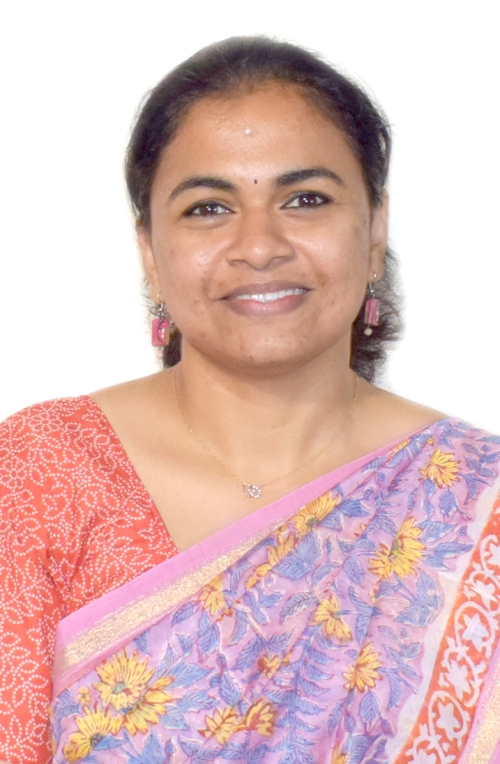
Shimna Manoharan
Assistant Professor
Civil Engineering
- B.Tech(Hons)., M.Tech., PG ( Machine Learning) IISc
- Recipient of Research Grant of ₹4.5 Lakhs from the Bureau of Indian Standards (BIS) for research in geotechnical engineering.
- Successfully completed the AICTE-QIP-PG Certification Program on "Machine Learning" at the Indian Institute of Science (IISc), Bengaluru.
- GATE Qualified with a All India Rank of 503 First Rank Holder in Bachelor of Engineering (Civil Engineering) from Government College of Engineering, Kannur with Honours.
- Manoharan, Shimna, Shashinaga, C., Pradeepa, U., & Pavana Kumara, P. R. (2021). Stabilization of sediment soil by Alccofine and Geogrid. In Proceedings of the Indian Geotechnical Conference 2019 (IGC-2019), Volume III (pp. 219–226). Springer Singapore.
- Hashmie, N., Gunagi, P., Belagal, P., & Manoharan, Shimna. (2020). Utilisation of recycled glass powder for the stabilization of black cotton soil by alkali activation. IOP Conference Series: Materials Science and Engineering, 955(1), 012063.
- Gopinath, R., Manoharan, Shimna, Likhith, M., Bhuvan, P. G., Kailash, R., Akash, M., & Anupama, H. S. (2022). Augmentation of soil-moisture retention with natural hydrogel extracted from fenugreek seed husk for loamy soil with real-time monitoring using FC-28 sensors. ECS Transactions, 107(1), 1139.
- Anbazhagan, P., Bajaj, K., & Shimna, M. (2023). Smoothed and normalized design spectrum for Indian rock sites. In Earthquake Engineering and Disaster Mitigation: Contributions in the Honour of Late Professor D.K. Paul (pp. 1–36). Springer.
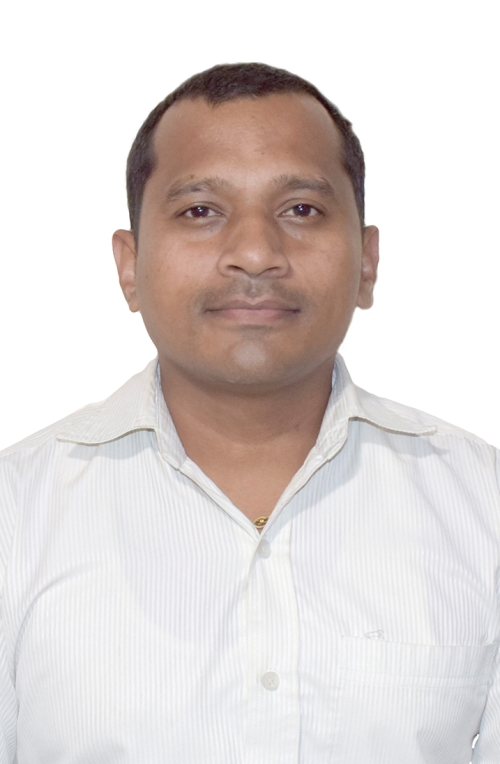
Dr Vinod B R
Assistant Professor
Civil Engineering
- B.E., M.Tech, Ph.D.,
- Authored five technical textbooks in the domain of Civil Engineering, contributing significantly to academic and professional education.
- Recognized as applicant and inventor with 4 granted patents, 2 published patent filings, and 1 granted.
- Recipient of the prestigious Nadaprabhu Kempegowda Award–2019 for outstanding contributions to the field of education, presented by the Chief Minister of Karnataka.copyright in the field.
- Received Padma Shri Dr S K Shivakumar Award 2022 from Karnataka Science and Technology Academy (KSTA) , Department of Science and Technology, Govt. of Karnataka Innovative Project Entitled “Smart city auto ticketing and Crowd Mangement for Bus Travel” .
- Received Padma Shri Dr S K Shivakumar Award 2021 from Karnataka Science and Technology Academy (KSTA) , Department of Science and Technology, Govt. of Karnataka Innovative Project Entitled “Autonomous System For Lake Water Quality Monitoring Using Real Time Data Analytics” .
- Received Padma Shri Dr S K Shivakumar Award 2020 from Karnataka Science and Technology Academy (KSTA) Department of Science and Technology, Govt. of Karnataka Innovative Project Entitled “Regulating water supply to reduce water wastage and ensure equal distribution of water in rural area” .
- Received Padma Shri Dr S K Shivakumar Award 2020 from Karnataka Science and Technology Academy (KSTA) Department of Science and Technology, Govt. of Karnataka Innovative Project Entitled “Prevention of Accidents caused due to landslides using ADRINO sensors.
- Secured funding from various government and non-government agencies for multiple research and development projects
- Geotechnical Engineering
- ACCE,IGS,NITTSD,ASCE,TERA,KSTA,IAENG
- B. R. Vinod, G A Swetha ,Department of Civil Engineering, Department of Chemistry BMS Institute of Technology and Management, “A Review of the Effects of Laser Cleaning on the Development of Corrosion and the Removal of Rust in Steel Bridges in Marine Environments “ Laser-Assisted Machining: Processes and Applications” , Wiley Publishers United States, ISBN 978-1- 394-21463-1 (eBook), Page Number : 129-144, 7th May 2024.
- B. R. Vinod, KR Ashwini, Department of Civil Engineering, Department of Physics BMS Institute of Technology and Management, “A Review of the Applications of the Laser Crack Measurement for White Topping Road “ Laser-Assisted Machining: Processes and Applications” , Wiley Publishers United States, ISBN 978-1-394-21463-1 (eBook), Page Number : 87-101, 7th May 2024.
- B. R. Vinod, KR Ashwini, Department of Civil Engineering, Department of Physics BMS Institute of Technology and Management, “Removing Algae and Moss Growth on Compressed Stabilized Earth Block Wall Surface by Laser Cleaning “ Laser-Assisted Machining: Processes and Applications” , Wiley Publishers United States, ISBN 978-1-394-21463-1 (eBook), Page Number : 69-85, 7th May 2024.
- R Shobha , B. R. Vinod “Pineapple fiber as an Effective Thermal Insulator Compared to other Insulating Materials ” Innovations and Applications of Fiber-Reinforced Concrete, Materials science and Technologies , Nova Science Publishers, New York , ISBN 978-8-89113-529-1 (eBook), DOI: https://doi.org/10.52305/EWVP0213 Page Number : 135-154, 6th March 2024.
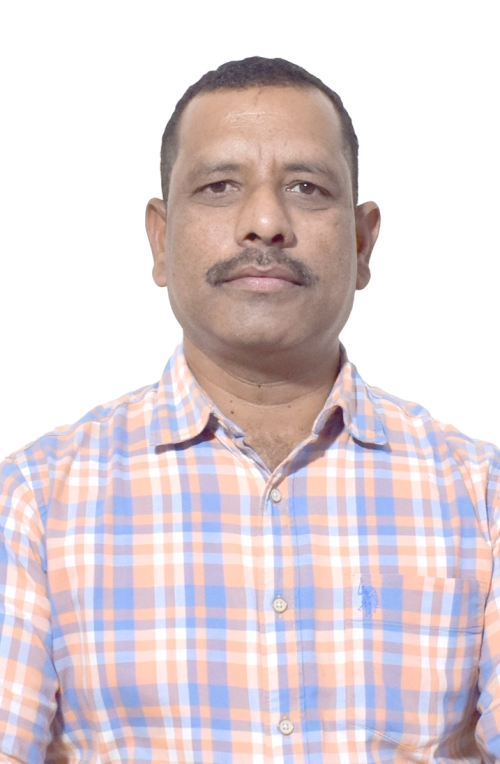
Dr. Chandrashekharappa Agasnalli
Assistant Professor
Civil Engineering
- B.Sc., M.Sc., Ph.D
- Engineering Geology
- Geological Society of Indian (GSI, LM 0216).
- Indian Beauru of Mines (IBM - Reg No. RQP/GOA/259/2015/A).
- Mining Engineers Association of India (MEAI, LM 3366)
- Chandrashekharappa AGASNALLI 1), M. S. DEEPAK 1) *, T. K. LAKKUNDI 2) and V. G. Ajey KUMAR 3) AN INTEGRATED STUDY OF LANDSAT ETM AND CARTOSAT DEM DATA IN IDENTIFICATION OF BANDED IRON FORMATIONS (BIFs) ASSOCIATED WITH SULPHIDE MINERALIZATION. DOI: 10.13168/AGG.2021.0041
- Chandrashekharappa Agasnalli, Kantharaja D Chandrappa and T K Lakkund A study of primary sedimentary structures in banded iron formations (BIFs) of Nagavi area, Gadag schist belt, Karnataka, India. ISSN 0022-2755
- Chandrashekharappa Agasnalli ⇑ , MS. Deepak, CN. Adikeshava Reddy, Global view of lateritic soil improvement for construction purposes in tropical countries. https://doi.org/10.1016/j.matpr.2022.05.158
- Chandrashekharappa Agasnalli a, ⇑, H.C. Hema b, Tejaswai Lakkundi c, Kantharaja D Chandrappa Integrated assessment of granite and basalt rocks as building materials, https://doi.org/10.1016/j.matpr.2022.03.546
- Hema HC1, Nagendra P2, Chandrashekharappa Agasnalli3, Govindiah S4,Hydrogeomorphological Assessment of Kanakapura Watershed Using Geo-Spatial Technology, Eur. Chem. Bull. 2023,12(10), 4143-4156
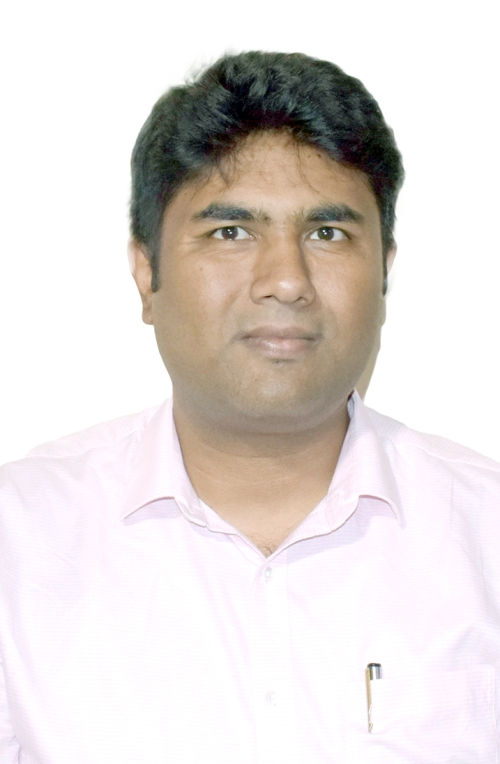
Dr Deepak M S
Assistant Professor
Civil Engineering
- B.E., M.E., Ph.D.,
- DST-SERB-ANRF-TARE [₹18.3 Lakhs].
- Ph.D., and M.E., Sponsored Research Under TEQIP-II-AICTE- GCT-Coimbatore-Anna University Chennai, Gold Medalist in Bachelor of Civil Engineering-BIT-Sathyamangalam-Anna University Chennai.
- Government Approved Class-1A - Structural Stability Engineer, Chartered Engineer, Chartered Valuer (Immovable Properties)-India.
- Patent Granted IPR (513875)- COLD FORMED STEEL HYBRID DOUBLE T BOX GIRDERS
- Structural Engineering
- The Panel of Private Practicing Engineers (CLASS- 1A), The Nilgiris District, 2018.
- Licensed Structural Stability Engineer (Rc. N3/6976/2017), Dated: 04.01.2018
- Associate Member of Institute of Engineers- India, (AMIE) Year: 2016
- Chartered Engineer, C.Eng. (I) (AM1665270)-2 016
- Associate Life Member of The Indian Institution Valuers- India, (A.I.I.V) Dated: 10.02.2018
- Chartered Valuer (immovable property), LM/CAT-I/A-5286, Dated: 10.02.2018
- Life Member Indian Society for Technical Education (MISTE) (LM 129595) Year: 2019
- Member American Society for Civil Engineers (M. ASCE) (M- 11970999) Year: 2020
- Chartered Engineer American Society for Civil Engineers (C.Eng.) Year: 2020
- Licensed Building Surveyor Coonoor- (Roc. No. F1/736/2014)), Dated: 27.02.2014
- Volunteer of National Service Scheme (NSS) – A
- M.S. Deepak and G. Beulah Gnana Ananthi, ‘Buckling Capacities of Double-T-Box Girders-A Numerical Approach’, Structures, 2021, Vol. 34, pp. 4574-4595. https://doi.org/10.1016/j.istruc.2021.10.046 [ELSEVIER]
- M.S. Deepak and G. Beulah Gnana Ananthi, ‘Local buckling behaviour and capacities of Cold-Formed Steel Double-I-Box stub and short column sections’, Structures, 2021, Vol. 34 (2021), pp. 1761-1784. https://doi.org/10.1016/j.istruc.2021.08.124 [ELSEVIER]
- G. Beulah Gnana Ananthi, M.S. Deepak, Krishanu Roy, James B.P. Lim, ‘Influence of intermediate stiffeners on the axial capacity of cold-formed steel back-to-back built-up unequal angle sections’, Structures, 2021, Vol. 32, pp. 827-848. https://doi.org/10.1016/j.istruc.2021.03.059 [ELSEVIER]
- M.S. Deepak and S. Lavanya Prabha, ‘Characteristics of High-Strength High-Performance Concrete under Normal and Accelerated Curing’, ACI-Materials Journal, 2022, Vol. 119, No. 1, pp. 59-70. doi: 10.14359/51734255 [ACI]
- Chandrashekharappa Agasnall, M.S. Deepak, T. K. Lakkundi and V. G. Ajey Kumar, ‘An Integrated Study of Landsat ETM and Cartosat Dem Data in Identification of Banded Iron Formations (BIFS) Associated with Sulphide Mineralization’, Acta Geodynamica et Geomaterialia, 2022, Vol. 19. PP. 35- 44. DOI: 10.13168/AGG.2021.0041 [CAS]
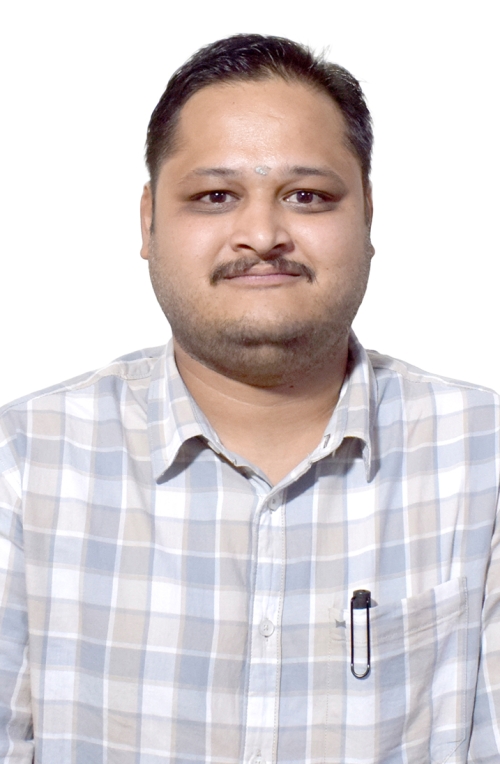
Dr Anupkumar G Ekbote
Assistant Professor
Civil Engineering
- B.E., Ph.D.,
- Successfully completed the consultancy of BMRCL project concerning testing of soil and rock samples.
- Geotechnical Engineering
- Ekbote, A. G., and Nainegali, L. (2019). “Interference of two closely spaced footings embedded in unreinforced and reinforced soil medium: a finite element approach using ABAQUS.” Arabian Journal of Geosciences, 12 (22), 683. DOI: 10.1007/s12517-019-4868-0.
- Ekbote, A. G., and Nainegali, L. (2021). “Finite element analysis of two nearby interfering asymmetric footings embedded in cohesionless foundation medium.” Geomechanics and Geoengineering, 16 (4), 263-276. DOI: 10.1080/17486025.2019.1664776.
- Ekbote, A. G., and Nainegali, L. (2023) “Behaviour of interfering embedded footings laid in unreinforced and reinforced sand medium” Current Sciences, 125 (4), 392-400. DOI: 10.18520/cs/v125/i4/392-400.
- Ekbote, A. G., Nainegali, L., Rajhans, P., and Deepak, M.S. (2022) “Behavioural assessment on influence of adjacently placed strip footings at different embedment level” Architecture Civil Engineering Environment, 15 (4), 93-103. DOI: 10.2478/ACEE-2022-0041.
- Ekbote, A. G., and Nainegali, L. (2023). “Study on closely spaced asymmetric footings embedded in a reinforced soil medium” Ingeniería e Investigación, 43 (3), e101082-e101082. DOI: 10.15446/ing.investig.101082.
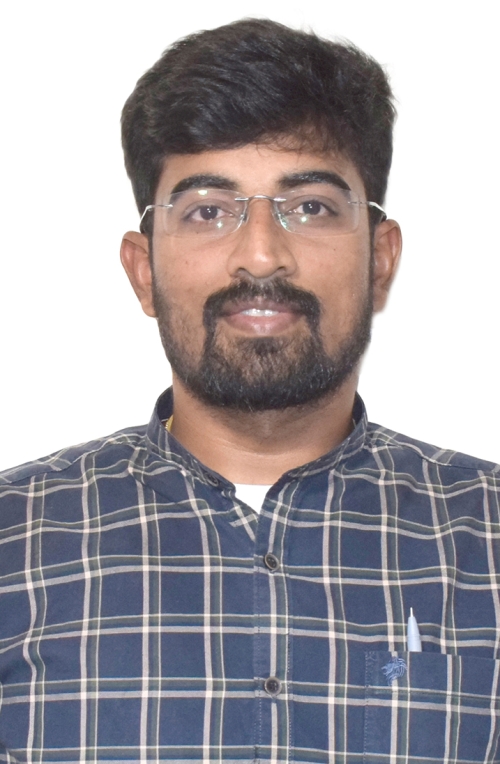
Dr Athiyamaan V
Assistant Professor
Civil Engineering
- B.Tech, M.Tech, Ph.D.
- Structural Engineering
- ISET, ICE, IAE, IIBE
- Athiyamaan. V Admixture-based self-compacted concrete with self-curing concrete techniques a state of art of review, Cleaner Engineering and Technology, 2021, 5, 100250
- Athiyamaan. V and G. Mohan Ganesh Experimental, “Statistical And Simulation Analysis On Impact Of Micro Steel - Fibres In Reinforced SCC Containing Admixtures” Construction and Building Materials (Journal) 2020, Vol.246, 118450. ISSN: 0950- 0618.
- Athiyamaan. V and G. Mohan Ganesh, “Optimization of SCC Mix Design Using Nan-su Theory Embodying Doe Method” Indian concrete journal (Journal) 2018, Vol.92, Issue.1, pp.31-41 ISSN 0019- 4565.
- Athiyamaan. V and G. Mohan Ganesh, “Analysis on Alignment of Microsteel Fibres in Admixture Based Self compacting Concrete (MSFR- SCC) Using NDT and Evaluating Its Effect on Modulus of Rupture” International journal of technology (Journal) 2019, Vol.10 (1):5 p-ISSN : 2086- 9614 e-ISSN : 2087- 2100.
- Athiyamaan. V and G. Mohan Ganesh, “Statistical and Detailed Analysis on Fiber Reinforced Self- Compacting Concrete Containing Admixtures- A State of Art of Review” IOP Conf. Series: Materials Science and Engineering 2017 263-032037.
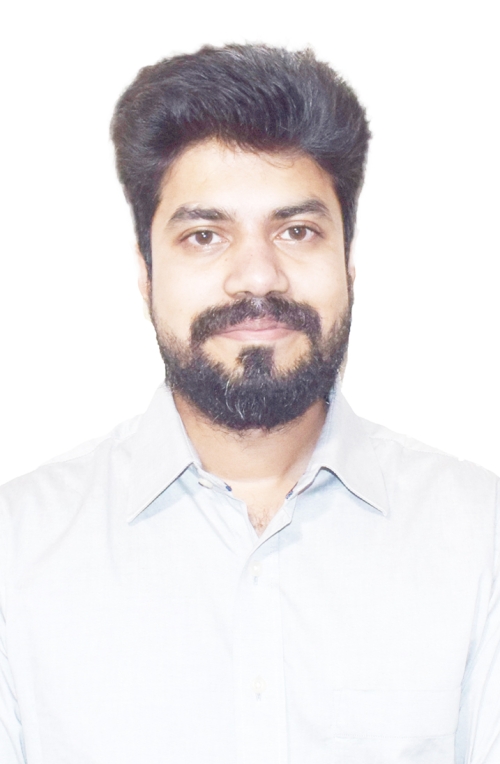
Dr. Marsh M. Bandi
Assistant Professor
Civil Engineering
- B.E., M.Tech., PhD
- Received a Certificate of Appreciation for Outstanding Contribution towards Academics in the year 2022-2023 during the Teacher’s Day Celebrations 2023 at BMSIT&M.
- Received a Certificate of Appreciation for Outstanding Contribution towards Academics in the year 2021-2022 during the Engineer’s Day Celebrations 2022 at BMSIT&M.
- Received a Certificate of Appreciation for Outstanding Contribution in Managing Autonomous Examinations 2021-2022 during the Engineer’s Day Celebrations 2022 at BMSIT&M.
- Transportation Engineering
- George, Varghese, and Bandi, Marsh M. (2015). “A Demonstration of a Single Variable Genetic Algorithm Optimization for a 2-Phase Traffic Signal.” Proc. Second International Conference on Information Technology, Science, Engineering, and Management (ICITSEM-215), held at Hyatt Place, Al-Rigga, Dubai, UAE. 25-26 Feb, pp.34-39. Received Best Paper Award and Gold Medal.
- George, Varghese, Purumala, Snehith, Tamhane, Ishan S., Reddy, Sreeja, Ranjusha, P.G., Bandi, Marsh M., and Anand, Akash (2016). “Fitting Statistical Distributions for Speeds and Headways for Peak and Non-Peak Mixed Traffic Flows in Mangalore City Karnataka, India.” International Journal of Earth Sciences and Engineering, Vol. 9, No. 2, pp. 512-520. ISSN 0974-5904. Scopus Indexed Journal 2010-16. H-Index: 9, Impact Factor: 0.13.
- Bandi, Marsh M., and George, Varghese (2020). “An Isolated Traffic Signal Design using a GA-based Optimization Technique.” International Journal of Recent Technology and Engineering (IJRTE), Vol. 8, Issue 5, pp. 2598-2604. Indexed in Google Scholar, IF: 5.92 (2018), ISSN: 2277-3878 (Online). DOI:10.35940/ijrte. E6261.018520.
- Bandi, Marsh M., and George, Varghese (2020). “Microsimulation Modelling in VISSIM on Short-term and Long-term Improvements for Mangalore City Road Network.” Transportation Research Procedia, 48, Pub. Elsevier, pp. 2725-2743. ISSN: 2352-1465 (Online). Scopus Indexed Journal from 2014 to present, H-Index: 25, CiteScore: 2.5, Source Normalized Impact per Paper (SNIP): 0.945, SCImago Journal Rank (SJR): 0.476. DOI: 10.1016/j.trpro.2020.08.243.
- Bandi, Marsh M., and George, Varghese (2020). “Calibration of Vehicle and Driver Characteristics in VISSIM and ANN-based Sensitivity Analysis.” International Journal of Microsimulation, Vol. 13(2), Research Article, ISSN: 1747-5864. Scopus Indexed Journal from 2015 to Present, H-Index: 4, IF: 3.091 (2021), CiteScore: 0.9, Source Normalized Impact per Paper (SNIP): 0.510, SCImago Journal Rank (SJR): 0.213. DOI: https://doi.org/10.34196/ijm.00219.
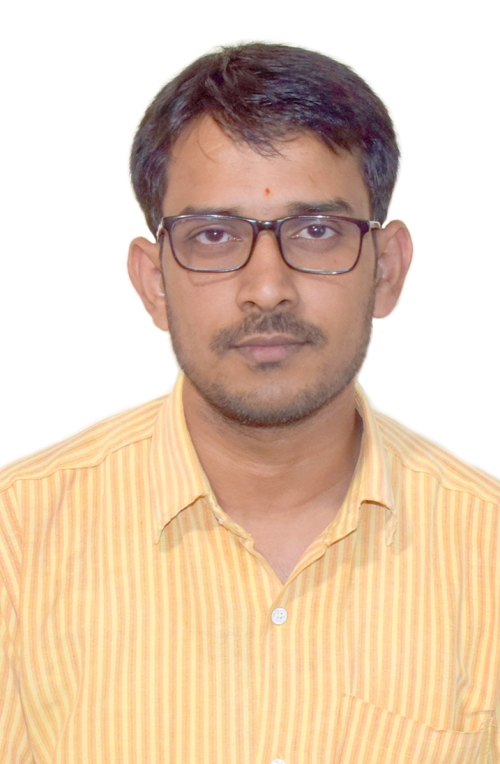
Dr. Lalit Kumar Gupta
Assistant Professor
Civil Engineering
- B.Tech., M.Tech., PhD
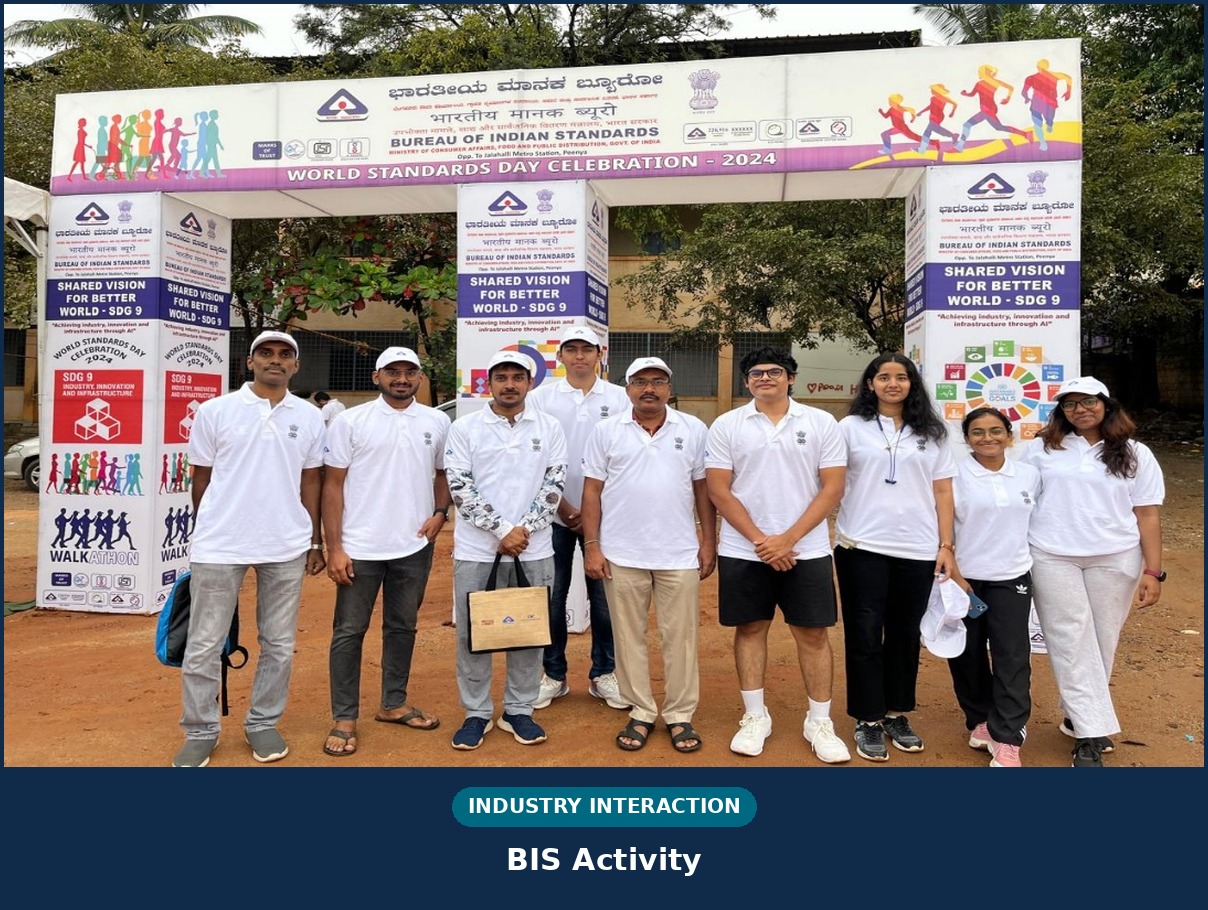
- Received a Letter of Appreciation for Outstanding Contribution for Mentorship from BIS Bengaluru during the World Standards Day - 2024 Celebration held at Hotel Taj.
- Received a Letter of Appreciation for Excellent Coordination from BIS Bengaluru during the Standards Carnival at BMSIT&M on 03-01-2025.
- Received a Certificate of Appreciation for Outstanding Contribution for Managing Website 2022-2023 during the Engineer’s Day Celebrations 2023 at BMSIT&M.
- Received a Certificate of Appreciation for Outstanding Contribution towards Academics in the year 2022-2023 during the Teacher’s Day Celebrations 2023 at BMSIT&M.
- Structural Engineering
- Associate Member - Institution of Engineers of India (IEI)
- Impact on mechanical properties of cement sand mortar containing waste granite powder Construction and Building Materials, Volume 191, Year 2018, Pages 155-164 DOI:10.1016/j.conbuildmat.2018.09.203
- Durability performance of waste granite and glass powder added concrete Construction and Building Materials, Volume 252, Year 2020 DOI:10.1016/j.conbuildmat.2020.119075
- Strength and durability studies on slag cement concrete made with copper slag as fine aggregates Materials Today: Proceedings, Volume 38, Year 2020, Pages 2639-2648 DOI:10.1016/j.matpr.2020.08.232
- Effect on Physical and Mechanical Properties of Cement Mortar Prepared with Waste Granite Powder as Secondary Aggregate UKIERI Concrete Congress, Concrete : The Global Builder, Year 2019 Analysis of Existing Pedestrian Facilities at Selected Areas of Jaipur City IRJET, Volume 07, Year 2020
Research
Driving Innovation Through Research and Real-World Impact.
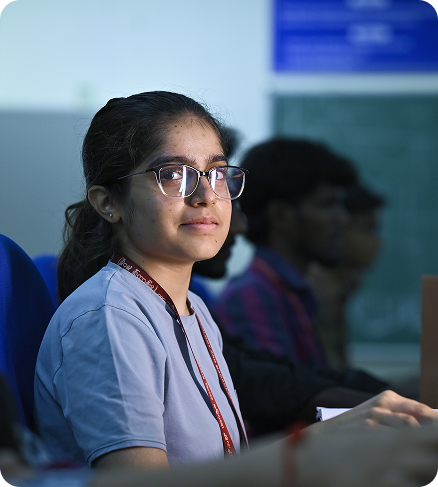
The Civil Engineering Department at BMSITM has demonstrated a vibrant research culture from 2022 to 2025, producing 35 peer-reviewed publications, all of which feature student co-authorship, reflecting its strong mentorship and academic–research integration. The department’s work spans sustainable and advanced materials (high-performance and pervious concrete, nano-modified mixes, sludge and industrial by-product reuse), structural and seismic studies (cold-formed steel, finite element analysis, soil–structure interaction), geotechnical innovations (pile behaviour, ML models for soils), water resources and environmental engineering (storm-water runoff modelling, groundwater recharge, carbon sequestration), and remote sensing and GIS applications, with even biodiversity documentation. Published across reputable venues, including ASCE, Elsevier, and Springer, this body of work underscores BMSITM Civil’s commitment to impactful, practice-oriented, and student-driven research that addresses both local and global challenges.
DEPARTMENT ACTIVITIES
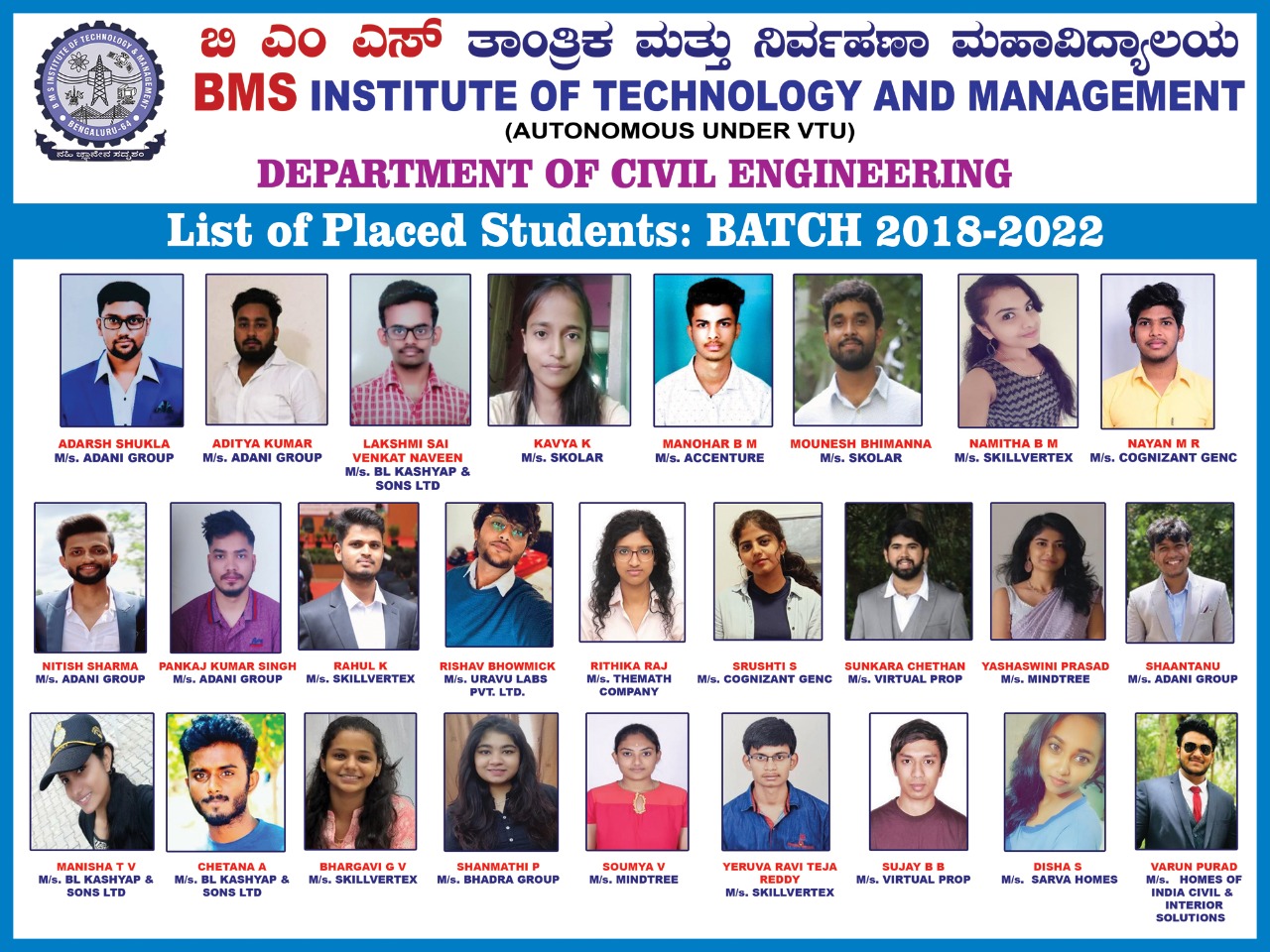
Achievements
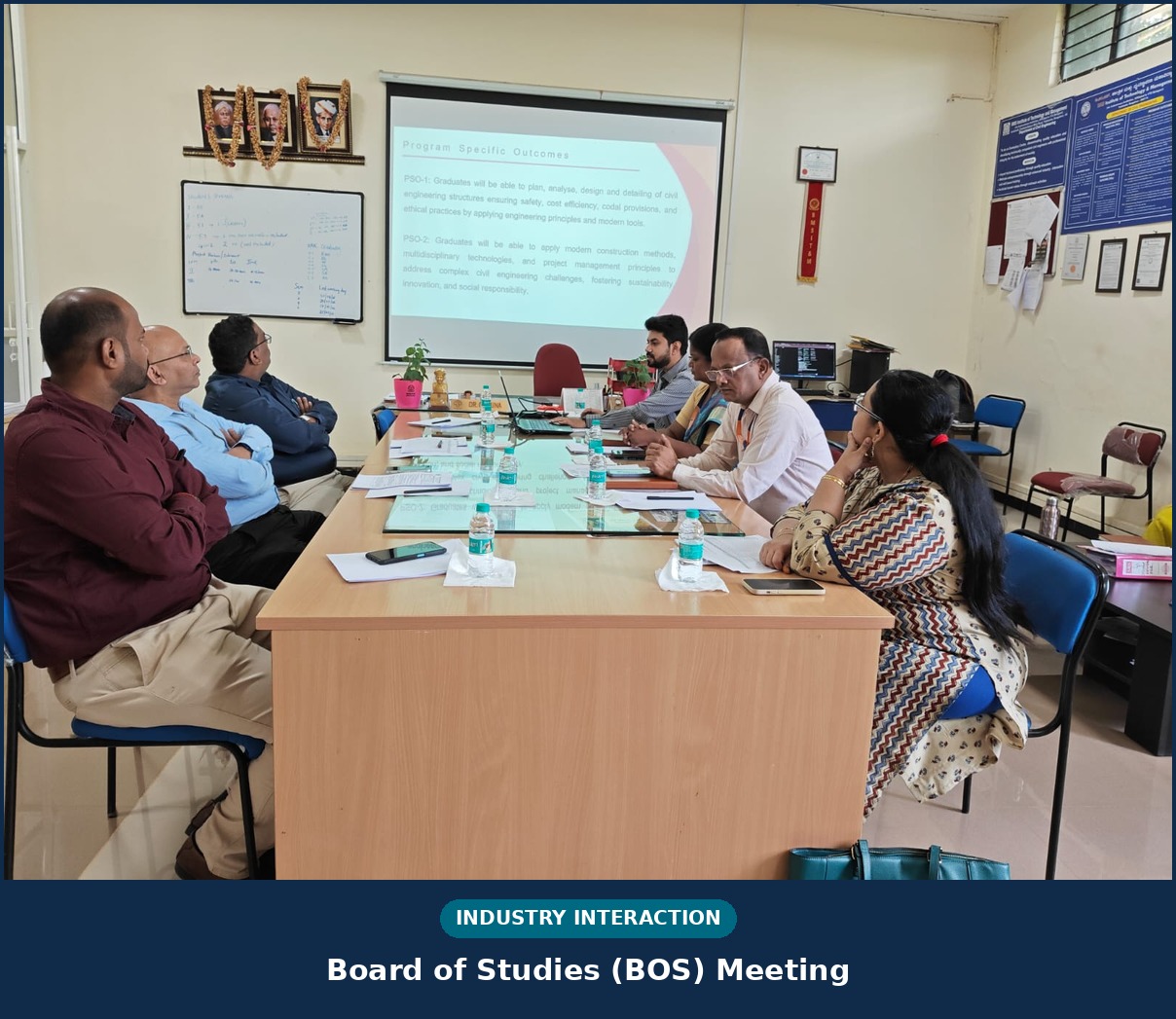
Board of Studies (BoS):
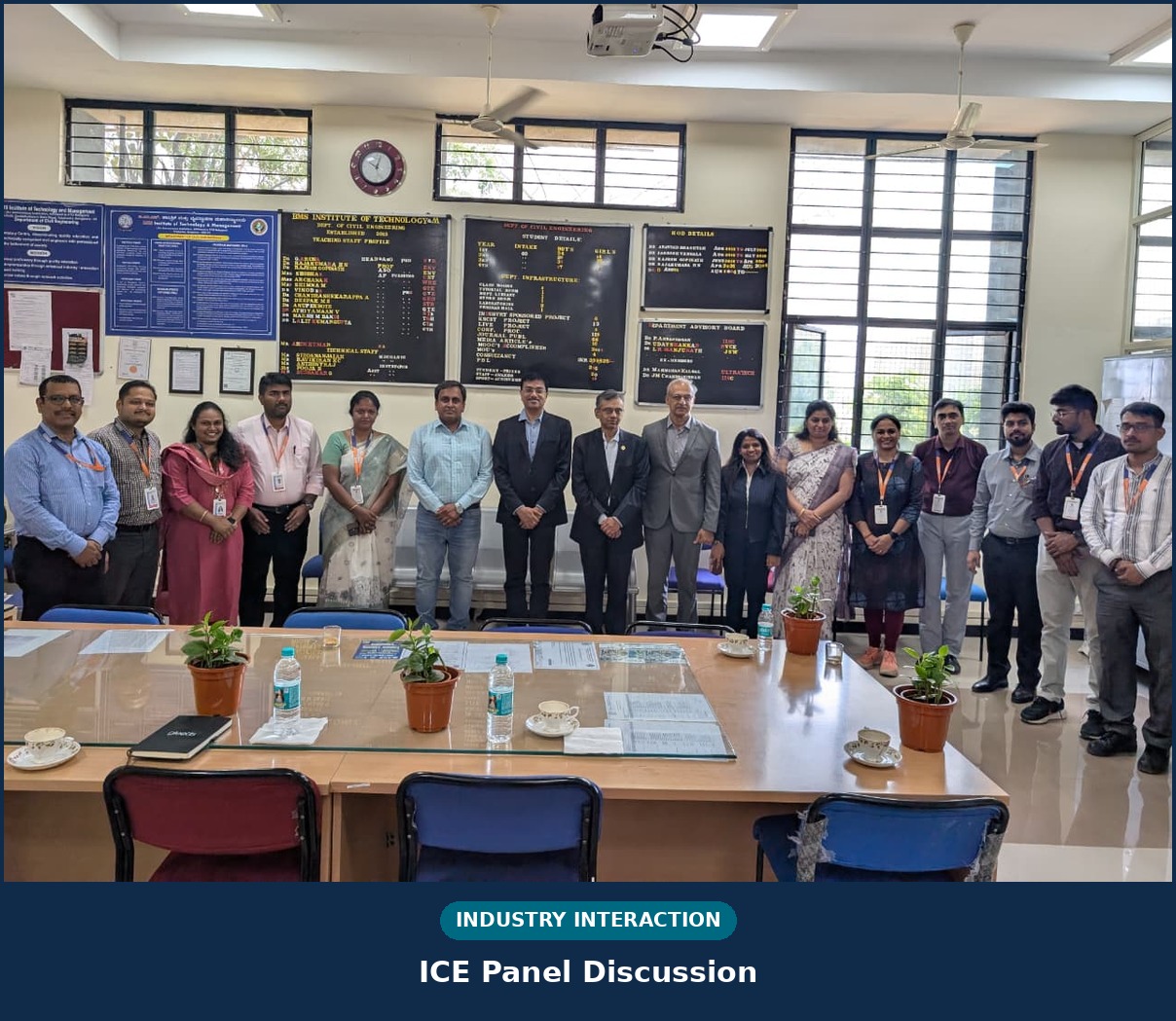
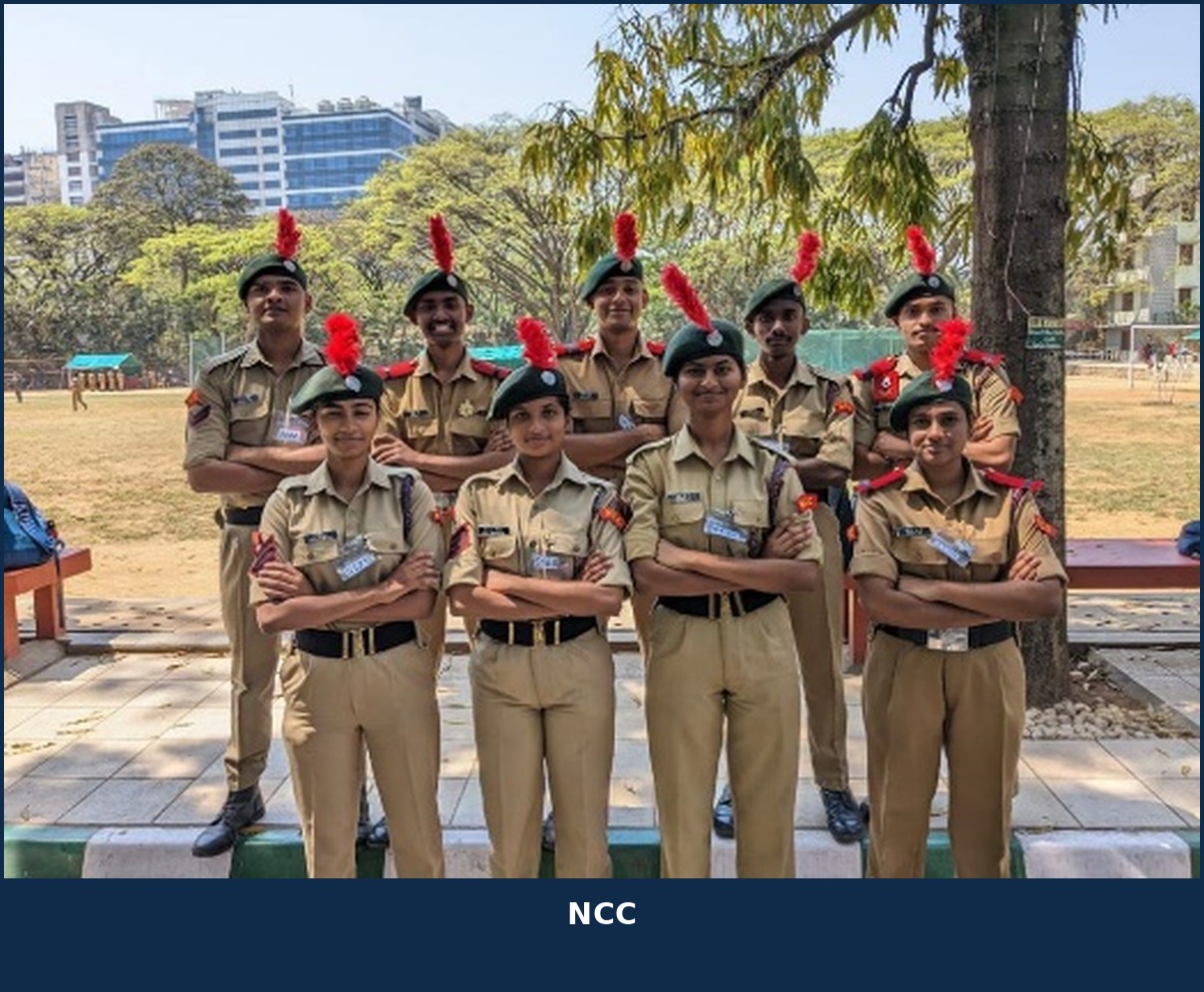
Gallery