
Electrical and Electronics Engineering

- Course Duration:
- Intake:
- Faculties:
COURSE OVERVIEW
Department of Electrical & Electronics Engineering was started in the year 2003-04 with an approved intake of 60 students. Since the year 2021 – 22, BMSIT&M has become an Autonomous institute under VTU. The curriculum development for the BE Program has been done keeping in mind the requirements of the industry. The Department has a team of well-qualified, experienced, and dedicated faculty who also have undergone professional training from leading organizations in “Teaching-Learning Methodologies.” Many of our faculty are members of the Board of Examinations of various Institutes/Universities. All the laboratories that were set up initially are constantly upgraded, keeping in view both University requirements and Research activity in the Department.
The students are encouraged to work on both in-house projects and with leading Research Organizations in Electrical Sciences. Every year students and faculty members have been publishing technical papers in National & International Journals. The campus placement is excellent. Apart from this, many students have secured admission in prestigious Universities abroad. In the recent past, the students graduating from the Department have been placed in reputed core Electrical Engineering companies and Information Technology consulting companies. The Department is a VTU-approved research center. The EEE BE Program is reaccredited by NBA for three years, 2022-2025.
The pedagogy of the Department is shifting towards Outcome Based Education. As part of this, an Academic Council has been set up to take valuable suggestions and views on the activities happening in the Department. The annual techno-cultural fest of the Department titled “Vidyut” is planned and organized by the students. The faculty members of the Department, through the e-Studio facility, have created an online open-access video lecture series for the critical courses accessible to all.
VISION
To emerge as one of the finest Electrical & Electronics Engineering Departments facilitating the development of competent professionals, contributing to the betterment of society.
MISSION
Create a motivating environment for learning Electrical Sciences through teaching, research, effective use of state of the art facilities and cocurricular activities.
- Have successful professional careers in Electrical Sciences, and Information Technology enabled areas and be able to pursue higher education.
- Demonstrate ability to work in multidisciplinary teams and engage in lifelong learning.
- Exhibit concern for environment and sustainable development.
- PO1 Engineering Knowledge: Apply knowledge of mathematics, natural science, computing, engineering fundamentals and an engineering specialization as specified in WK1 to WK4 respectively to develop to the solution of complex engineering problems.
- PO2 Problem Analysis: Identify, formulate, review research literature and analyze complex engineering problems reaching substantiated conclusions with consideration for sustainable development. (WK1 to WK4)
- PO3 Design/Development of Solutions: Design creative solutions for complex engineering problems and design/develop systems/components/processes to meet identified needs with consideration for the public health and safety, whole-life cost, net zero carbon, culture, society and environment as required. (WK5)
- PO4 Conduct Investigations of Complex Problems: Conduct investigations of complex engineering problems using research-based knowledge including design of experiments, modelling, analysis & interpretation of data to provide valid conclusions. (WK8).
- PO5 Engineering Tool Usage: Create, select and apply appropriate techniques, resources and modern engineering & IT tools, including prediction and modelling recognizing their limitations to solve complex engineering problems. (WK2 and WK6)
- PO6 The Engineer and The World: Analyze and evaluate societal and environmental aspects while solving complex engineering problems for its impact on sustainability with reference to economy, health, safety, legal framework, culture and environment. (WK1, WK5, and WK7)
- PO7 Ethics: Apply ethical principles and commit to professional ethics, human values, diversity and inclusion; adhere to national & international laws. (WK9)
- PO8 Individual and Collaborative Team work: Function effectively as an individual, and as a member or leader in diverse/multi-disciplinary teams.
- PO9 Communication: Communicate effectively and inclusively within the engineering community and society at large, such as being able to comprehend and write effective reports and design documentation, make effective presentations considering cultural, language, and learning differences
- PO10 Project Management and Finance: Apply knowledge and understanding of engineering management principles and economic decision-making and apply these to one’s own work, as a member and leader in a team, and to manage projects and in multidisciplinary environments.
- PO11 Life-Long Learning: Recognize the need for, and have the preparation and ability for i) independent and life-long learning ii) adaptability to new and emerging technologies and iii) critical thinking in the broadest context of technological change. (WK8)
Program Outcomes (POs)
Knowledge and Attitude Profile (WK)
- WK1 A systematic, theory-based understanding of the natural sciences applicable to the discipline and awareness of relevant social sciences.
- WK2 Conceptually-based mathematics, numerical analysis, data analysis, statistics and formal aspects of computer and information science to support detailed analysis and modelling applicable to the discipline.
- WK3 A systematic, theory-based formulation of engineering fundamentals required in the engineering discipline.
- WK4 Engineering specialist knowledge that provides theoretical frameworks and bodies of knowledge for the accepted practice areas in the engineering discipline; much is at the forefront of the discipline.
- WK5 Knowledge, including efficient resource use, environmental impacts, whole-life cost,reuse of resources, net zero carbon, and similar concepts, that supports engineering design and operations in a practice area.
- WK6 Knowledge of engineering practice (technology) in the practice areas in theengineering discipline.
- WK7 Knowledge of the role of engineering insociety and identified issues in engineering practice in the discipline, such as the professional responsibility of an engineer topublic safety and sustainable development.
- WK8 Engagement with selected knowledge in the current research literature of the discipline, awareness of the power of critical thinking and creative approaches to evaluate emerging issues.
- WK9 Ethics, inclusive behavior and conduct. Knowledge of professional ethics, responsibilities, and norms of engineering practice. Awareness of the need for diversity by reason of ethnicity, gender, age, physical ability etc. with mutual understanding andrespect, and of inclusive attitudes.
- Analyze electrical power systems with regard to operation, control, and protection.
- Apply the knowledge of electrical machines and power electronic controllers to design and implement efficient and reliable electrical drive systems.
- Design analog and digital electronic systems for developing home & industrial automation system
Faculty List
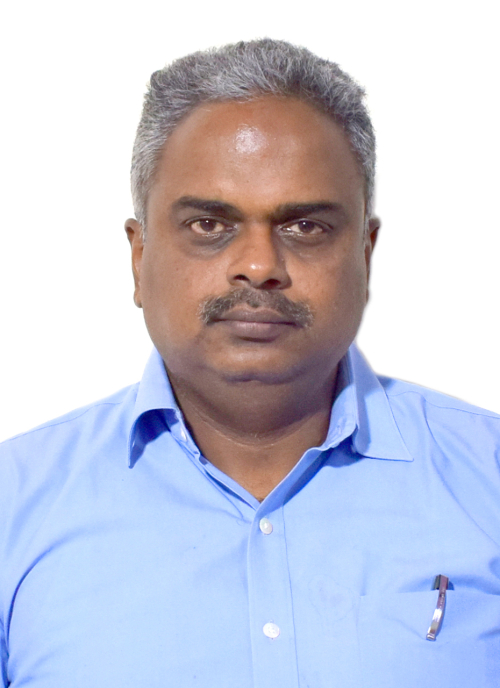
Dr. Prashanth N A
Associate Professor & HOD
Electrical & Electronics Engineering


M.Tech, P.hD
Wind Power Systems
1. Biomedical Engineering Society of India 2. Institution of Electronics and Telecommunication Engineers
- "[1] Prashanth. A and P. Sujatha “Commonly used Wind Generator Systems: A Comparison Note”, Indonesian Journal of Electrical Engineering & Computer Science” Vol.7, No. 2, August 2017, pp.299-311."
- "[2] Prashanth.N. A and P. Sujatha “MAGNETIC FLUX MAXIMIZATION IN PMSG BY HYBRIDIZATION OF RBF NEURAL NETWORK AND PSO”, “Journal of Advanced Research in Dynamical & Control Systems”, Vol 10, 08-Special Issue, 2018. "
- "[3] Prashanth. N. A and P. Sujatha “Optimal Volume Design of Small Scale PMSG using Multi- population Particle Swarm Optimization”, “Journal of Advanced Research in Dynamical & Control Systems”, Vol 11, No.5, 2019."
- "[4] Prashanth. N. A and P. Sujatha “Natural Computing based wind turbine blade design performance optimization”, International Journal of Applied Engineering Research ISSN 0973-4562 Volume 12, Number 15 (2017) pp. 4790-4798."
- "[5] Characterization of a compact low cost 6.5kV Cockcroft voltage multiplier Palati M.;Ananda P.N. Bulletin of Electrical Engineering and Informatics, Volume 11, Year 2022, Pages 1789-1797"
Dr. G. Raghavendra
Professor
Electrical & Electronics Engineering

PhD
Sucessfully worked as academic head, BOE member, BOS member at university level
Power systems, Electric Vehicles, Smart Grid
Institute of Engineers (MIE), Senior Member The International Association of Electrical, Electronic and Energy Engineering (IAEEEE)
- . “An Efficient Fault Tolerant and Cost Optimized Power Model for Distributed Power Generation System”- Journal of Advanced Research in Dynamical and Control Systems (JARDCS) (Scopus indexed) 2018
- “A Strategy for Managing Energy in Standalone DC microgrid with PV and Dual Battery System” - International Journal of Intelligent systems and applications in Engineering IJISAE, 2023, 11(10s), 523–528
- . “Estimation of Potential Outage Risk Evaluation of System using Performance Indices” - International Journal of Intelligent systems and applications in Engineering IJISAE, 2024, 12(13s), 41
- “An Algorithm for Power Sharing in a Standalone DC Microgrid Cluster with Centralized Storage”- International Journal of Computational and Experimental Science and Engineering (IJCESEN) Vol. 11-No.3 (2025) pp. 4661-4668
- “Modeling and analysis of field-oriented control based permanent magnet synchronous motor drive system using fuzzy logic controller with speed response improvement” - International Journal of Electrical and Computer Engineering (IJECE) Vol. 12, No. 6, December 2022, pp. 6010~6021 ISSN: 2088-8708, DOI: 10.11591/ijece.v12i6.pp6010-6021
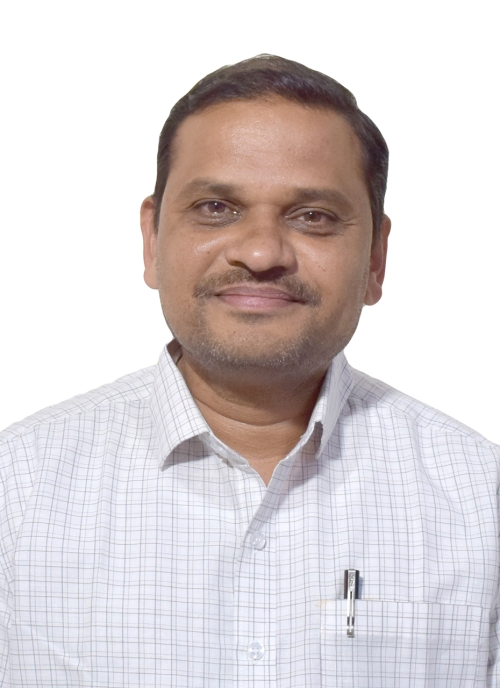
Dr. Narapareddy Ramarao
Associate Professor
Electrical & Electronics Engineering
Ph.D
High Voltage Engineering, Control and Automation
IEI
- Dielectric and structural properties of polyaniline-tungsten trioxide nanocomposites: For the packing of nano-electronic devices and EMI shielding, MN Taj, BD Prasad, N Ramarao, H Nagabhushana, A Reddy, KR Ashwini, Nano-Structures & Nano-Objects 39, 101219
- PANI-molybdate nanocomposites: Structural, morphological and dielectric properties for the effective electromagnetic interference (EMI) shielding applications in X-band, MN Taj, BD Prasad, R Narapareddy, H Nagabhushana, G Ramakrishna, Applied Surface Science Advances 7, 100203
- "Multi-Population based PSO algorithm for optimization of small-scale wind turbine PMSG NA Prashanth, V Chekuri, N Ramarao, AIP Conference Proceedings 2418 (1), 040006"
- Voltage Collapse Estimation Using Singular Value Decomposition in an Integrated Power System, V Chekuri, PNA Narapareddy Ramarao, Solid State Technology 63 (6), 19162-19170
- "Polymer-silicate nanocomposities: Package material for nanodevices as an EMI shielding MN Taj, B Darukaprasad, NR Rao, H Nagabhushana, KS Anantharaju, Materials Today: Proceedings 46, 6017-6021"
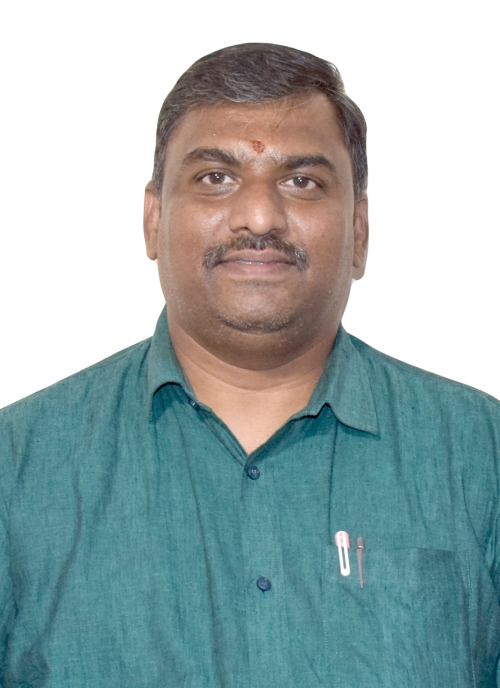
Dr. Manjunatha Babu P
Associate Professor
Electrical & Electronics Engineering
Ph.D.
Power and Energy Systems
ISTE, IETE, Life Membership
- A Hybrid Technique for Estimating the State of Health of Lithium-Ion Batteries. https://onlinelibrary.wiley.com/doi/abs/10.1002/oca.3248
- A Novel Method for Contingency Ranking Based On Voltage Stability Criteria in Radial Distribution Systems. https://link.springer.com/article/10.1007/s40866-022-00137-y
- Reliability enhancement of radial distribution system by placing the reactive power compensators and distribution systems. https://beei.org/index.php/EEI/article/view/4515
- Different Electrical Vehicles Load Demand Forecast Using ITFCZNN-SAO Approach. https://doi.org/10.1504/ijise.2025.10072209
- Design & Simulation for 2kW EV Charger Using MATLAB SIMULINK. DOI: 10.1109/COMP-SIF65618.2025.10969861
Dr. Suma Umesh
Assistant Professor
Electrical & Electronics Engineering
Ph.D.
"1. Principal Investigator for a funded project from NRB, DRDO, GoI.
2. Best Teacher Award from Congnizant-BMSIT.
3. Carried out a 6 months research project on potent green house gas sensors at CeNSE, IISc, funded by INUP, GoI. "
Nano materials and Embedded Systems.
IEEE, ISSS, IEEE
- Carbonaceous ZnO nanocomposite for sensing of H2S at sub-ppm concentrations, Suma Umesh, S Varadharajaperumal, SA Shivashankar, M Srinidhi Raghavan, Fullerenes, Nanotubes and Carbon Nanostructures, 2021, Talor and Francis.
- Nanocrystalline Spinel CoFe2O4 Thin Films Deposited via Microwave-Assisted Synthesis for Sensing Application, suma Umesh, A Usha, K Bailey, K Sujatha… - Journal of Electronic Materials, 2022.
- Active power factor correction technique for single phase full bridge rectifier, Suma Umesh, L Venkatesha, A Usha - 2014 International Conference on Advances in Energy …, 2014
- Design and simulation of MEMS gas sensor topologies for detection of inert gases, Suma Umesh, TC Balachandra, A Usha - Materials Today: Proceedings, 2018, Elsevier.
- Design, simulation and analysis of MEMS based Piezoresistive Cantilever sensor, N Veena, TC Balachandra, S Umesh - Materials today: proceedings, 2018, Elsevier.
Dr. Prashant Athavale
Assistant Professor
Electrical & Electronics Engineering
Ph.D
Signal Processing, Automation
IEEE PES, IUPRAI, ISTE
- """Synergistic enhancement of thermal energy conversion in twin wedge solar stills using graphene nano-coated absorber and nano-composite PCM Solar Energy Materials and Solar Cells, Volume 295, Year 2026 DOI:10.1016/j.solmat.2025.113982"""
- """An MPPT Charge Controller for Solar PV Installations Using the Incremental Conductance Method Proceedings of 2025 International Conference on Computing for Sustainability and Intelligent Future Comp Sif 2025, Year 2025 DOI:10.1109/COMP-SIF65618.2025.10969962"""
- Deep Learning Based Environmental Sound Classification http://dx.doi.org/10.1109/NMITCON62075.2024.10699074
- A Fusion Method for Automated Segmentation of the Lungs from the Chest X-Rays ASIC Springer, Year 2020
- """Automated delineation of costophrenic recesses on chest radiographs Advances in Intelligent Systems and Computing, Volume 906, Year 2019, Pages 89-101 DOI:10.1007/978-981-13-6001-5_7"""
Prof. Manjula B K
Assistant Professor
Electrical & Electronics Engineering
MTech
Topper of top 5% in NPTEL course " Smart Grid: Basics to Advanced Technologies "offered by IIT Roorkee in November 2024
VLSI Design and Embedded system
Institute of Smart Structures and Systems , ISTE
- Presented a Research paper at IEEE conference at NIT Patna titled "Smart Card Based EV Parking System with DC Charging" http://dx.doi.org/10.1109/ICEFEET64463.2024.10866117
- Presented research paper at AIP conference titled "Signal conditioning circuit of linear variable differential transformer.http://dx.doi.org/10.1063/5.0090087
- 12th International Conference on Advances in Computing Control and Telecommunication Technologies Act 2021 "Development of displacement measurement circuit of linear variable differential transformer"
- 15th International Conference on Advances in Computing Control and Telecommunication Technologies Act 2024 "PLC based Fault Detection and Protection of a Three Phase Induction Motor"
Dr. Vikram Chekuri
Assistant Professor
Electrical & Electronics Engineering
M.E
"Secured all India 396 rank in GATE-2012 with 99.5 percentile, Twice topper in NPTEL Courses."
Power System
ISTE, IUPRAI
- Multi population based PSO algorithm for optimization of small scale wind turbine PMSG, Vikram Chekuri,Prashanth N A, N. Ramarao, International conference on Research in Sciences, Engineering and Technology-2021, 13.02.2021, SRITW
- “Power Quality Enhancement using DSTATCOM”, Vikram Chekuri, Narapareddy Ramarao, GIS Science Journal, ISSN: 1869-9391, Volume 8, Issue 10, 2021, PP 862-868, https://DOI:20.18001.GSJ.2021.V8I10.21.38136
- Vikram Chekuri, Narapareddy Ramarao, Prashanth N.A ""Voltage Collapse Estimation Using Singular Value Decomposition in an Integrated Power System"", Solid State Technology, ISSN 0038-111X , vol.63, Issue.6, 19162-19169, Dec-2020.
- Vehicle Monitoring using IOT and Automatic Stop-Start System, Vikram Chekuri, Firas Ahmed, Sharath S.K, Shivakumar Somasagar, Akilesh S.K, International Research Journal of Engineering and Technology (IRJET), ISSN: 2395-0056, Volume 7, Issue 6, June 2020.
- V. Chekuri and Kumudini Devi R.P., "Transient voltage stability enhancement using Static Synchronous Compensator," 2014 International Conference on Advances in Electrical Engineering (ICAEE), Vellore, India, 2014, pp. 1-5, doi: 10.1109/ICAEE.2014.6838507.
Dr. Babu Naik Gugulothu
Assistant Professor
Electrical & Electronics Engineering
Ph.D
Power System
" Institute of Smart Structures and Systems-ISSS (Life Membership)"
- "1. Gugulothu, Babu Naik, Sanjay Lakshminarayanan, Madhu Palati, Suresh Haleyur Lakshmegowda, and Mahipal Bukya. ""A practical case study on effect of moisture ingress in power cables and methods to reduce equipment failure."" Engineering Research Express 7, no. 1 (2025): 015313.
- 2. Gugulothu, Babu Naik, Sanjay Lakshminarayanan, Madhu Palati, Suresh Haleyur Lakshmegowda, and Mahipal Bukya. ""Assessing moisture content in XLPE power cables using frequency-dependent tangent delta measurements."" Materials Research Express 12, no. 2 (2025): 025301.
- 3. Gugulothu, Babu Naik, Sanjay Lakshminarayanan, Madhu Palati, Suresh Haleyur Lakshmegowda, and Mahipal Bukya. ""A study of XLPE insulation failure in power cables under electromagnetic stress."" Engineering Research Express 6, no. 3 (2024): 035352.
- 4. Gugulothu, Babu Naik, Sanjay Lakshminarayanan, Madhu Palati, and Suresh Haleyur Lakshmegowda. ""A novel method to improve the residual life of switchgear by reducing the impact caused by thermal and mechanical stresses produced due to SLG cable faults in electrical substations."" Journal of Advanced Research in Fluid Mechanics and Thermal Sciences 106, no. 2 (2023): 68-77.
- 5. Babu Naik, G., and Sanjay Lakshminarayanan. ""Cable faults identifying review and procedure for new instrument."" In Intelligent Computing Techniques for Smart Energy Systems: Proceedings of ICTSES 2021, pp. 361-371. Singapore: Springer Nature Singapore, 2022. "
- "6. Prashanth, N. A., Babu Naik Gugulothu, G. Shilpa, Hadeel Alsolai, Irfan Ahmad Khan, and S. Mayakannan. ""Enhancing Trust and Integrity in IoT-Fog Networks Using Blockchain-Based Auditing."" In Next-Generation Computational Intelligence: Trends and Technologies, pp. 323-352. Cham: Springer Nature Switzerland, 2025.
- 7. Gugulothu, Babu Naik, Ranveer Singh, Prakash Kumar, Prashant Raj, and Pasuvula Harika. ""Wireless Technology-Based Charging System for Electric Vehicles."" In International Conference on Emerging Research in Computing, Information, Communication and Applications, pp. 475-486. Singapore: Springer Nature Singapore, 2024.
- 8. Gugulothu, Babu Naik, Moinuddin Pasha, P. Deepa, K. Y. Kusuma, and Ponnam Naga Roopa. ""Solar Inverter Equipped with a Battery Management System."" In International Conference on Flexible Electronics for Electric Vehicles, pp. 423-434. Singapore: Springer Nature Singapore, 2022.
- 9. Babu Naik, G. ""Monitoring of critical buses in real-time by using PMU for 72-Bus."" In Intelligent Computing Techniques for Smart Energy Systems: Proceedings of ICTSES 2021, pp. 431-440. Singapore: Springer Nature Singapore, 2022.
- 10. Babu Naik, G., Prerit Ameta, N. Baba Shayeer, B. Rakesh, and S. Kavya Dravida. ""Convolutional neural network based on self-driving autonomous vehicle (cnn)."" In Innovative Data Communication Technologies and Application: Proceedings of ICIDCA 2021, pp. 929-943. Singapore: Springer Nature Singapore, 2022."
- "11. Naik, G. Babu. ""Real-time monitoring of buses utilizing phasor measurement units for a 24-bus system."" In International Conference on Advances in Electrical and Computer Technologies, pp. 881-890. Singapore: Springer Nature Singapore, 2021.
- 12. Lakshminarayanan, Sanjay, Kiran Kumar, S. Nagaraja Rao, and S. Pranupa. ""Current mode control of single phase grid tie inverter with anti-islanding."" International Journal of Power Electronics and Drive Systems 12, no. 1 (2021): 241.
- 13. Kargaran, Mahyar, Hamid Reza Goshayesh, Iman Zahmatkesh, and Seyed Reza Saleh. ""Next-Generation Cooling Strategies for Photovoltaics: A Review of Pathways Toward High Efficiency, Low Carbon, and Climate Resilience."" Results in Engineering (2025): 108556.
- 14. Sreeja, S. P., D. Sreenivasulu, Alok Jain, Neeraj Chahuan, Fatimah Dhari Jabbar, and Babu Naik Gugulothu. ""A Robust BMS Framework for DC Fast Charging in Smart Grid-Integrated EVs."" In 2025 International Conference on Next Generation Communication & Information Processing (INCIP), pp. 268-273. IEEE, 2025.
- 15. Jayanthi, Muthuswamy, Pendyala Shamili Srimani, Manish Gupta, Ankit Meheta, Hazim Y. Saeed, and Babu Naik Gugulothu. ""Exploring the Thermal Runaway Mechanism in High-Energy Lithium-Ion Batteries."" In 2025 International Conference on Next Generation Communication & Information Processing (INCIP), pp. 352-356. IEEE, 2025."
Prof. Ozwin Dominic D'Souza
Assistant Professor
Electrical & Electronics Engineering
M.Tech
Power Electronics and Drives
SOLAR ENERGY SOCIETY OF INDIA (SESI), LM/2163/2016
- "Optimized energy management for hybrid renewable energy sources with Hybrid Energy Storage: An SMO-KNN approach, Journal of Energy Storage, Elsevier "
- A Hybrid Technique for Estimating the State of Health of Lithium‐Ion Batteries, Journal: Optimal Control Applications and Methods, John Wiley & Sons, Inc.
Prof. Shilpa G
Assistant Professor
Electrical & Electronics Engineering
M.Tech
Received certificate of appreciation for being recognized as NPTEL DISCIPLINE STAR JAN-APR 2025
Power Electronics and Drives
Solar Energy Society of India (SESI)
- Hybrid HVDC system for multi-infeed applications
- Optimized energy management for hybrid renewable energy sources with Hybrid Energy Storage: An SMO-KNN approach
- Solar operated smart elevator
- Comparison of Different Topologies of Multilevel Inverter
- A Hybrid Technique for Estimating the State of Health of Lithium‐Ion Batteries
Prof. Nagaraj D Chonali
Assistant Professor
Electrical & Electronics Engineering
M.Tech (Ph.D)
Completed Funded Project " Retrofitting of Conventional Three Wheeler Autorikshaw into Electrical Autorikshaw"
VLSI, Electric Machines, Automation
ISTE, BMESI
- IMPLEMENTATION OF EIGHT POINT FFT ALGORITHM USING INTERVAL ARITHMETIC ON FPGA
- Automated Waste Segregator using Renesas Microcontroller
- Design of an Electric Drive-Train for Retrofit of a Conventional Auto-Rikshaw into an Electric Auto-Rikshaw
- Smart Roadways – An Optimistic Approach towards the Road Safety and Traffic Rules
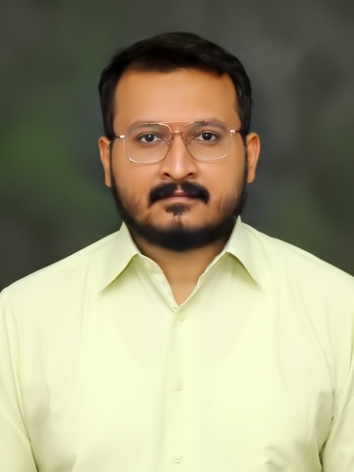
Dr. Abhinandan Kumar
Assistant Professor
Electrical & Electronics Engineering
Ph.D.
Power Systems
- A Newton‐Raphson‐based unified load flow of grid‐connected and islanded AC–DC microgrids
- An algorithm for contingency analysis of the AC-DC networks using modified Z-bus technique
- An AC Z-bus-based distribution factors for contingency analysis of AC–DC networks
- Sensitivity Factor Analysis of Hybrid AC–DC Distribution System and Overload Alleviation Using Modified Generator Shift Distribution Factor

Dr. Pramod Bhat Nempu
Assistant Professor
Electrical & Electronics Engineering
Ph.D
Renewable Energy Based Distributed Generation Systems
Associate Member, The Institution of Engineers (India)
Praveena Krishna, P. S., Jayalakshmi N. Sabhahit, Vidya S. Rao, Amit Saraswat, Hannah Chaplin Laugaland, and Pramod Bhat Nempu. "Optimizing EV Powertrain Performance and Sustainability through Constraint Prioritization in Nonlinear Model Predictive Control of Semi-Active Bidirectional DC-DC Converter with HESS." Sustainability 16, no. 18 (2024): 8123.
Bhat Nempu, Pramod, and N. S. Jayalakshmi. "Coordinated power management of the subgrids in a hybrid AC–DC microgrid with multiple renewable sources." IETE Journal of Research 68, no. 4 (2022): 2790-2800.
Nempu, Pramod Bhat, Jayalakshmi Narayana Sabhahit, Dattatreya Narayan Gaonkar, and Vidya Sudarshan Rao. "Novel Power Smoothing Technique for a Hybrid AC-DC Microgrid Operating with Multiple Alternative Energy Sources." Advances in Electrical & Computer Engineering 21, no. 2 (2021): 99.
Nempu, Pramod Bhat, and Jayalakshmi Narayana Sabhahit. "Stochastic Algorithms for Controller Optimization of Grid Tied Hybrid AC/DC Microgrid with Multiple Renewable Sources." Advances in Electrical & Computer Engineering 19, no. 2 (2019): 53.
Sabhahit, Jayalakshmi N., Dattatraya N. Gaonkar, and Pramod B. Nempu. "Integrated power flow and voltage regulation of stand-alone PV–fuel cell system with supercapacitors." International Journal of Power and Energy Systems 37, no. 1 (2017): 1-9.
Research
Driving Innovation Through Research and Real-World Impact.
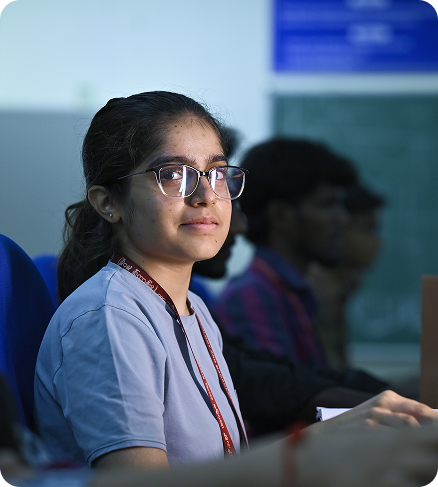
The EEE department at BMSIT&M also emphasizes a strong culture of undergraduate research, innovation, and hands-on learning. Students are encouraged to work on industry-relevant and socially impactful projects, integrating theoretical knowledge with practical implementation. With continuous mentoring from faculty, students actively participate in national-level technical competitions, hackathons, and project exhibitions, demonstrating excellence in design, analysis, and problem-solving.
Student projects and innovations cover diverse areas such as renewable energy systems, electric mobility, IoT-based smart grids, automation, power converters, energy auditing, and intelligent control applications. The department maintains a consistent record of research publications in reputed journals and conferences, with faculty and students contributing to advancements in electrical and energy engineering. The department has also received support and funding for research and development projects from government agencies, professional bodies, and industry partners, strengthening its academic and research ecosystem.
DEPARTMENT ACTIVITIES
Student Activities
| Student Activities | |
|---|---|
| MOOC’s completed (NPTEL, MATLAB Onramp etc) | 413 |
| Hackathons Conducted | 03 |
| Technical Talks | 15 |
| Industrial Visits | 10 |
| Industry-Offered Short-Term Training program | 01 |
| Number of Projects participated exhibition | 18 |
Achievements
Student Achievements
- Ms. Kavya T. has won Third Place in Individual Kumite in 50 kg division at State Level Tournament organised by VTU.
- Yashraj Praful Barai finished 97th Rank Running race held during 2023 TATA Greater Bengaluru 10K race.
- Ms. Shreya G S and Mr. Deepanshu Bhardwaj received the Best Paper Award in the 2nd IEEE International conference on Networks, Multimedia and Information Technology at Nitte Meenakshi Institute of Technology, Bengaluru.
- Team SRJAN – Runner-Up, Solar Decathlon India 2025, competed along with BMSSA.
- Shreela Upasana H N, Satish Kumar M, Sahana T M, Monika A, Dhivin M Kumar, and P Mrutunjaya Dash of 8th sem won 2nd place and a cash prize of Rs. 75,000 in national level Smart India Hackathon - 2022.
- Samarth Srinivas of 1st sem represented Karnataka state from Bangalore Urban district in the Federation Cup 2022 Inline Hockey held at Jodhpur from 26th to 29th July 2022 and also participated in 60th National Roller Skating Championships – Roller and Inline Hockey held at Bengaluru from 11th to 22nd December 2022.
- Yashraj Praful Barai of 6th sem completed 10 km, 5 km, and 3 km run in Bengaluru 10K on 08-01-2023 and 18 km run in Greater and One8 Run on 26-03-2023.
- The team of Karan Kishore, Vishakha Aithal, Gayatri Jaltare, and Vertika Srivastava of 6th sem received sponsorship of Rs. 8,000/- from KSCST for their project titled Design and Fabrication of Micro Drone for Surveillance of Hazardous Remote Environment. The guide for the team is Dr. Babu Naik G.
- Virajit B Shastry of 8th sem has been working in an NGO called Bloodconnect for the past two years and has been awarded the PAN INDIA Volunteer.
Faculty Achievements
- Published 13 journal papers, 32 International conference papers, and 12 book chapters in reputed national and international publications.
- Currently guiding 10 Ph.D. research scholars, and 2 scholars have successfully been awarded the Ph.D. degree.
- Filed and published 2 patents as part of their research activity.
- Dr Suma Umesh completed an NRB Project on Micro Gas Sensors worth 5.25 lakhs.
- Obtained a seed grant of ₹5 lakhs from the Institute for undertaking a research project focused on EVs : Dr Prashanth N A.
- Membership in various professional societies like IETE, IEEE, ISTE, BMSI.
- Recognition as an NPTEL Discipline Star for the Jan–Apr 2025 semester : Mrs Shilpa G.
- Qualified the Karnataka State Eligibility Test (KSET) for Assistant Professor in 2024: Dr Mamatha N.


